
80/20 Rule in
Animal Training
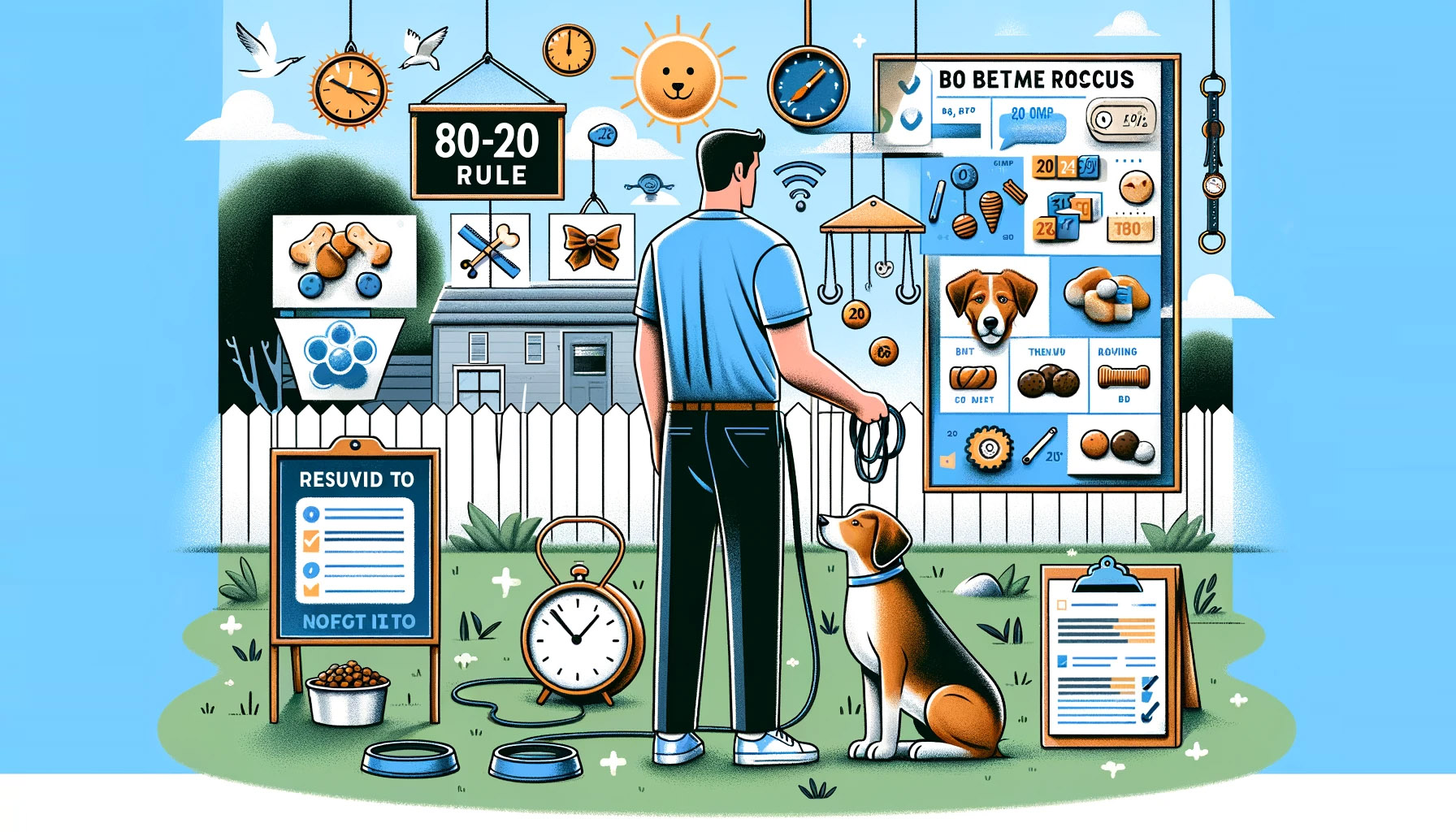
A dog that blows past its owner at the park chasing a squirrel, ignoring every "come here" shouted at increasing volume, is not usually a stubborn dog. It is a dog that has never been reinforced enough, at the right moment, for choosing its owner over the squirrel. A horse that plants its feet at the trailer ramp is not being difficult either. It has learned, through repetition, that the trailer usually means something uncomfortable is about to happen.
The 80/20 rule is useful here because training genuinely rewards focus. A small number of foundation behaviors prevent most day-to-day conflict with a pet. A small number of reinforcers explain most of an animal's motivation in a session. And a handful of owner habits, more than the animal's temperament, explain most of what looks like "training failure." Find those few levers for your animal and species, and the rest of training gets much easier.
Train the Behaviors That Prevent the Most Trouble
Not every command carries equal weight. A dog that reliably comes when called, walks without dragging its owner down the street, settles on a mat on cue, and tolerates being touched, brushed, and examined avoids the large majority of situations that turn into a bad day: an off-leash dog running toward traffic, a guest getting jumped on, a vet visit that turns into a wrestling match. Complex tricks rarely prevent any of that, no matter how impressive they look.
80/20 example: For most pet dogs, four behaviors, reliable recall, loose-leash walking, settling on a mat, and accepting handling, resolve the majority of daily friction. Walks, visitors, vet trips, and off-leash safety all improve once those four are solid, while teaching a dog to spin or shake a paw changes almost nothing about how livable the household is.
- Recall: keeps the animal safe around traffic, wildlife, and other dogs
- Loose-leash walking: turns every walk from a tug-of-war into something both of you enjoy
- Settle on a mat: gives the animal something to do instead of jumping, barking, or begging when things get busy
- Handling tolerance: makes grooming, vet visits, and medicating far less stressful for everyone involved
If you train nothing else this month, pick whichever of these four is currently weakest and drill it in short sessions across a few different locations. These same priorities hold up across most dog training approaches (see our guide to dog training) even when the specific method differs, and that one behavior will do more for daily life than a dozen new tricks.
Find the Reinforcer the Animal Actually Works For
Trainers talk about "high-value rewards" as if every animal wants the same thing. They do not. A reinforcer is defined by its effect on behavior, not by what a person assumes is appealing. Kibble might be plenty for a calm living room session and worthless at a busy dog park, where the same dog may only work for real chicken or a favorite tug toy.
| Reinforcer option | What it tests | When it tends to matter most |
|---|---|---|
| Kibble or dry treats | Baseline food motivation | Low-distraction settings, short home sessions |
| Soft, high-value treats (chicken, cheese) | Motivation under distraction | Parks, vet visits, new environments |
| Toy or tug | Play drive | Herding breeds and other high-energy animals |
| Sniffing or exploring | Environmental reinforcement | Walks, decompression time, scent-driven breeds |
| Distance from a trigger | Relief-based reinforcement | Fearful or reactive animals |
Run this as an actual test: offer two or three of these options in the context you plan to train in, and watch which one the animal works for, not which one you assumed would win. That ten-minute test tells you more about what will make training stick than any generic list of "best dog treats."
Keep Sessions Short Enough to End Before the Animal Quits
Marker training, a clicker or a consistent word, works because it tells the animal, within about a second, that the exact thing it just did earned reinforcement. That precision matters more than session length. Many experienced trainers run sessions of one to five minutes, several times a day, rather than one long half-hour block.
Fatigue and frustration erode a session fast. An animal that is still succeeding at minute two but starting to guess wrong at minute six has not gotten less capable, it has gotten less focused, and repetitions after that point often reinforce confusion rather than the behavior you actually want. Ending on a clean success and stopping is nearly always better than pushing for one more rep hoping it lands.
Fix the Owner's Routine, Not Just the Animal's Behavior
Most of what gets blamed on an animal's stubbornness or breed is actually inconsistency on the human side. If one family member rewards jumping with attention while another ignores it, the dog is not confused about the rule, there simply is not one yet. If a reward arrives five seconds after the behavior instead of within a second or two, the animal may end up reinforced for whatever it was doing at that later moment instead of the behavior you meant to reward.
8020 move: Pick the one household rule your training keeps breaking, usually reward timing or a family member who overrides the rule, and fix that single routine before adding any new command. Fixing one inconsistency in how everyone responds usually improves behavior faster than teaching an entirely new skill.
- Does the reward arrive within a second or two of the behavior, every time, from everyone in the house?
- Does everyone respond to jumping, barking, or begging the same way, instead of some people allowing it?
- Is the animal being asked to perform in an environment far harder than the one it was actually trained in?
That kind of habit-level consistency, more than talent or breed, predicts most training outcomes (see our guide to habits for building routines that actually stick).
Training Improves Fastest Where You Actually Look
None of this is specific to dogs. A parrot that only steps up for a trainer holding treats in a training room, a cat that will not enter a carrier, and a horse that will not load are all responding to the same short list of variables: which behaviors were actually reinforced, which reinforcer mattered in that moment, how long the session ran before frustration set in, and how consistent the routine around the animal has been. A small number of behavior problems, unsafe recall, resource guarding, separation distress, tend to cause a disproportionate share of an owner's daily stress, which is exactly why fixing them first pays off faster than teaching anything new.
The dog ignoring recall at the park and the horse planting its feet at the ramp are not separate problems needing separate philosophies. Both usually trace back to the same handful of levers: a foundation behavior that was never made reliable, a reinforcer that was not actually motivating in that context, a session that ran too long, or a routine that sent mixed signals. The same pattern shows up anywhere behavior is shaped by repeated consequences, including parenting (see our guide to parenting), where a few consistent responses matter far more than any single technique. Fix the few things that matter here, and most of what looked like a hard case turns out to be a training gap, not a stubborn animal.