
80/20 Rule in
Learning a Musical Instrument
If you want to learn a musical instrument faster, the best approach is not longer practice but more targeted practice. Most beginners do not quit piano, guitar, violin, drums, or saxophone because they lack talent. They quit because they spend months repeating whole songs while the same small technical problems keep tripping them.
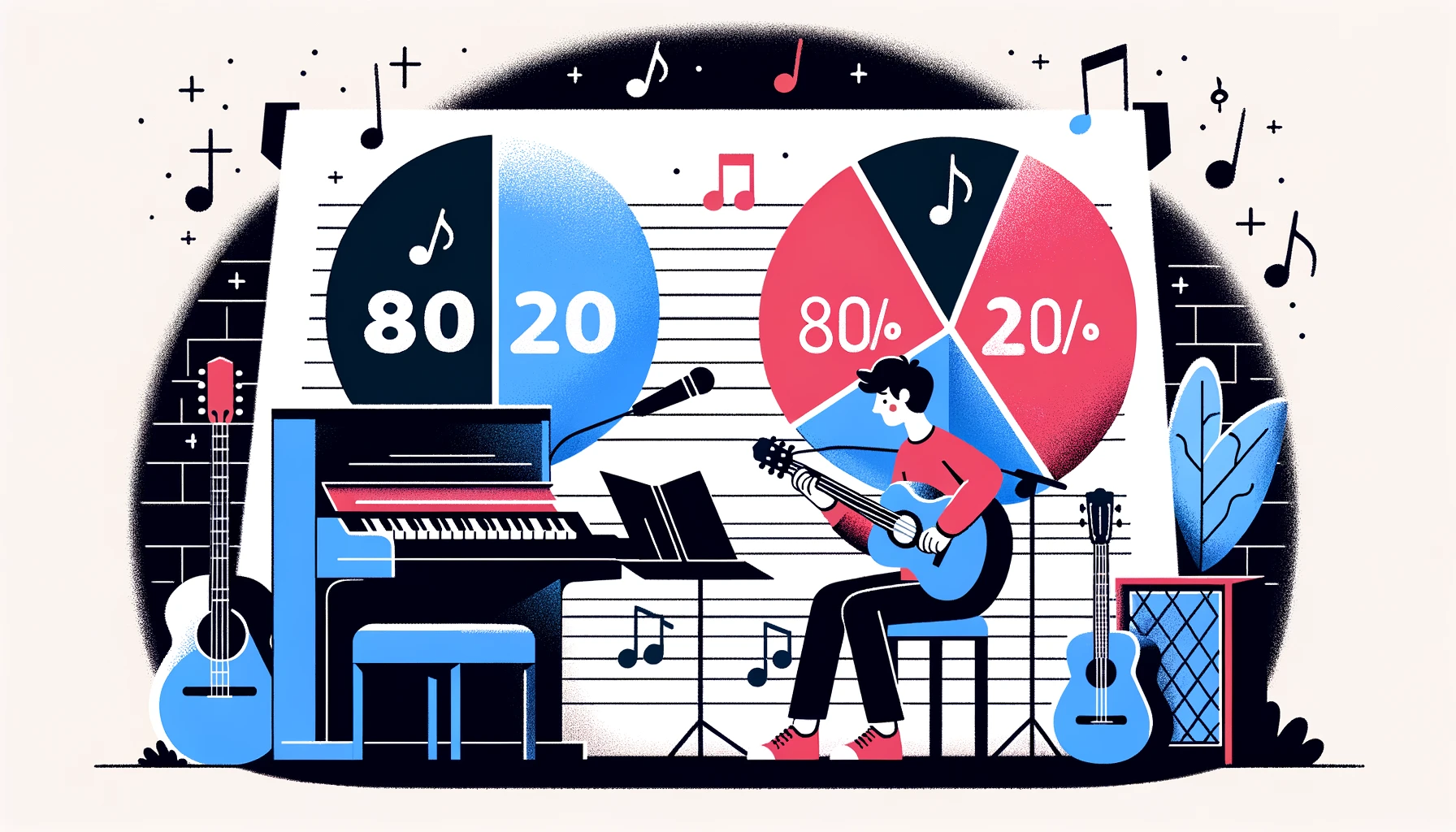
The 80/20 rule is a useful reminder here: a small share of your practice usually creates most of your improvement. In music, that small share is not flashy. It is timing, slow correction, reusable patterns, feedback, and choosing pieces that teach one clear skill at a time. Different instruments have different foundations, but those levers apply almost everywhere.
Improve Rhythm Before You Chase Speed
Beginners often obsess over right notes and ignore when those notes happen. But listeners notice unstable time immediately. A wrong note played in time can sound like color. A right note played late usually sounds like a mistake.
This is why metronome practice for beginners is not optional busywork. It gives you external feedback before your internal clock is reliable. If your rhythm is loose, every song feels harder than it should because your hands, ears, and counting are all fighting different pulses.
- Slow tempo practice: Set the metronome so slowly that you can play cleanly, even if that means 50 or 60 beats per minute. Clean time at a slow tempo beats messy speed.
- Count out loud: Say “1 and 2 and 3 and 4 and” while playing. If you cannot count it, you probably do not own the rhythm yet.
- Clap before you play: Clap the rhythm away from the instrument first, especially for syncopation, dotted notes, or rests. This separates the timing problem from the finger problem.
80/20 example: A beginner guitarist who spends 5 focused minutes daily switching G-C-D chords with a metronome may get more usable song progress than from 30 minutes of randomly strumming full songs, because those few chords and that steady pulse appear in a huge share of beginner repertoire.
The fastest way to improve rhythm and timing on an instrument is to stop treating rhythm as something you add later. Build it into the first repetition.
Stop Starting From the Beginning
The classic beginner loop is painful: start at bar one, play the easy opening, hit the same mistake in the middle, stop, sigh, and start again. That feels like practice, but it mostly rehearses the part you already know.
In many pieces, most breakdowns live in a small number of measures. That is the musical version of the 80/20 pattern: perhaps 20% of the measures cause 80% of the errors. Your job is to find those measures and make them boring.
For beginner piano, that might mean isolating the left hand for two bars, then the right hand, then combining both at half speed. For beginner guitar, it might mean practicing only the shift from C to F, because that one chord change ruins the whole verse. For violin, it might be a string crossing that needs ten slow, clean repetitions before the whole phrase is attempted.
This is deliberate practice for musicians: short, focused correction with feedback. It is not glamorous, but it is how you stop making the same mistakes in music practice. If you care about skill development, this is the point where music practice becomes training instead of repetition.
Build the Patterns That Reappear Everywhere
Music is full of reusable shapes. A beginner who learns every song as a separate pile of notes works too hard. A beginner who learns patterns starts recognizing the same material in new clothing.
On guitar, a small set of open chords such as G, C, D, Em, Am, A, and E unlocks many beginner songs. On piano, five-finger patterns, major and minor triads, I-IV-V progressions, and simple scales show up constantly. In Western tonal music, scales and arpeggios are not punishment from your teacher. They are compressed practice for hundreds of future passages.
How to practice scales effectively: play them slowly, evenly, and with a specific goal. One day the goal might be relaxed shoulders. Another day it might be identical volume on every note. Another day it might be counting aloud while the metronome clicks only on beats 2 and 4. A scale played mindlessly is a finger workout. A scale played with a target is high-yield practice.
| 80/20 pattern in music practice | What it means for a beginner |
|---|---|
| 20% of measures create most mistakes | Loop the difficult bars instead of replaying the whole song. |
| 20% of common chords unlock many songs | For guitar, drill clean open-chord transitions before chasing advanced solos. |
| 20% of rhythm problems make a piece sound amateur | Use a metronome early, not after the piece is “finished.” |
| 20% of listening details shape much of the performance | Copy phrasing, dynamics, breathing, and articulation from strong recordings. |
Why You Are Not Getting Better at Your Instrument
If you keep asking, “Why am I not getting better at my instrument?”, the answer is rarely one thing. It is usually a cluster of low-feedback habits that feel productive but do not force improvement.
- You practice too fast. Speed hides uneven timing, tension, and sloppy transitions.
- You always start from the beginning. This overtrains easy sections and undertrains the exact spots that fail.
- You avoid the metronome. Without a steady reference, you may not notice rushing or dragging.
- You choose pieces that are too hard. If every bar has a new problem, your brain cannot focus on one lesson.
- You never record yourself. You cannot fix what you cannot hear clearly.
The best way to practice an instrument as a beginner is to make the feedback loop shorter. Play a small section, check one thing, correct it, and repeat. This is also where strong practice habits matter more than motivation. A reliable 30-minute routine beats an inspired two-hour session once a week.
Use a 30-Minute Beginner Music Practice Routine
A beginner music practice routine should be simple enough that you can repeat it on a normal day. If you need a perfect mood, silent house, and unlimited time, the plan will collapse. Here is a practical music practice schedule for beginners who want to practice smarter, not longer.
- 5 minutes: rhythm and metronome. Clap the rhythm, count aloud, then play a tiny pattern at a clean tempo.
- 10 minutes: hardest measures. Pick the two bars or one chord change that caused yesterday’s mistake. Slow it down until it is accurate.
- 10 minutes: core patterns. Practice scales, chord transitions, arpeggios, bowing patterns, rudiments, or breath control, depending on your instrument.
- 5 minutes: record and review. Use your phone. Listen for one issue only: timing, tone, tension, or clean transitions.
That split is not magic, but it protects the vital few. It also supports better time management because each minute has a job. If you only have 15 minutes, cut each block in half. Do not skip feedback.
8020 move: For your next practice session, choose one song, one hard spot, one metronome tempo, and one recording to review before you put the instrument away.
Choose Pieces That Teach One Skill at a Time
Many self-taught musicians pick pieces only because they love them. That matters, because music should stay emotionally alive. But if a piece introduces a new key, new rhythm, new technique, fast tempo, and unfamiliar notation all at once, it is not a learning piece. It is a frustration machine.
Pick music where most of the material is already within reach and one specific skill stretches you. If you want to learn fingerpicking on guitar, choose a song with chords you already know. If you want to improve piano hand coordination, pick a short piece with simple notes but a left-hand pattern that repeats. If you want better breath control on flute or saxophone, choose a melody where phrasing is the main challenge, not note reading.
This keeps attention narrow. Your brain does not have to solve five new problems at once. It can spend most of its energy on the one skill you actually meant to develop.
Listen and Record Like a Coach Is in the Room
Active listening is practice when you listen with a task. Follow the score while hearing a professional recording. Mark where the performer gets louder, pulls back, breathes, attacks a note, or makes a phrase feel complete. Sheet music gives instructions, but recordings reveal musical behavior.
Recording yourself does the opposite. It removes the fantasy. While playing, your attention is busy with hands, breath, posture, reading, and memory. Playback shows what actually happened: rushed endings, uneven volume, buzzing strings, clipped notes, tense tone, or a left hand overpowering the right.
You do not need studio gear. A phone voice memo is enough. Record 30 seconds, listen once, choose one correction, and play again. This keeps practice concrete and protects your concentration from drifting into vague self-criticism.
FAQ: Smarter Practice for Beginner Musicians
How long should I practice an instrument each day? For many beginners, 20 to 30 focused minutes is enough to improve if the session includes rhythm, hard measures, core patterns, and feedback. Longer sessions help only if attention stays high.
Is 30 minutes of practice enough? Yes, if the practice is specific. Thirty minutes of slow correction beats two hours of playing songs from the top while ignoring the same mistake.
What is the fastest way to improve rhythm? Use a metronome, count aloud, clap subdivisions, and record yourself. Rhythm improves when you compare your timing against something objective.
Should beginners use a metronome? Yes. Use it early and slowly. The metronome is not there to judge you. It is there to show whether your pulse is steady before speed makes problems harder to hear.
Make the Instrument Feel Smaller
Learning a musical instrument feels overwhelming when every song looks like a new mountain. The 80/20 approach makes the mountain smaller. Improve timing first. Attack the hardest measures. Build reusable patterns. Choose pieces that stretch one skill. Listen, record, and correct quickly.
That is how to learn a musical instrument faster without pretending there is a shortcut around practice. The shortcut is inside the practice itself: fewer random repetitions, more focused corrections, and a steady habit of working on the small problems that create most of the sound.